
Learn · Cross-World · 4 min
Selling Your Business Changes More Than Your Balance Sheet
The money changes immediately. The rest of your life doesn't necessarily adjust as quickly.
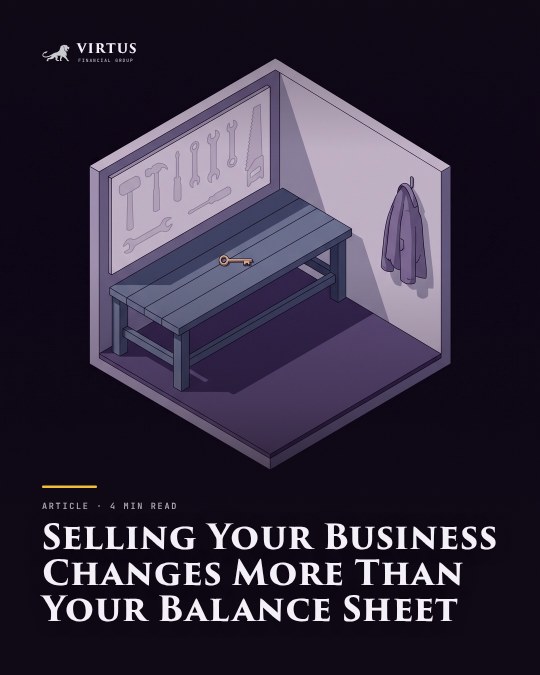
If you've owned a business for 20 or 30 years, selling it isn't just selling an asset.
Think about what the business does for you today. It may provide most of your income. A large percentage of your net worth may be tied up in it. It gives you somewhere to go every morning. People call you when something needs to be decided. And when somebody asks what you do, the business is probably part of the answer.
Then one day you sell it. The money changes immediately. The rest of your life doesn't necessarily adjust as quickly.
What the business does for you today
- Provides most of your income
- Holds a large percentage of your net worth
- Gives you somewhere to go every morning
- People call you when something needs to be decided
- It's part of the answer when somebody asks what you do
After the sale
- The income has to come from somewhere else
- The net worth is cash and investments now
- Monday morning still comes
- None of those decisions are yours anymore
- The answer to the question changes
The five things in the text. The money changes immediately. The rest adjusts more slowly.
What replaces the business income?
This is the first financial question I'd want answered before the sale.
Suppose the business pays you $300,000 a year and you sell it for $5 million. Having $5 million in the bank doesn't tell you whether you can continue living on $300,000 a year.
The example in the text. Hypothetical.
Start with what your life costsSome of the proceeds may go to taxes. Some may need to remain available for other goals. The remaining money has to support whatever job you've assigned to it for potentially decades.
So before getting too excited about the sale price, I'd want to know what your life actually costs and how much income needs to replace what the business currently provides. A $5 million sale can be a great outcome and still require real planning.
What happens to the money after the sale?
For years, a large part of your wealth may have been concentrated in something you understood better than almost anyone else: your business.
You knew the customers. You knew the employees. You understood what made money and what didn't. If something went wrong, you could usually do something about it.
After the sale, that wealth may suddenly be sitting in cash and investments. That's a very different relationship with money.
Now you have decisions about how much should remain liquid, how much should be invested, how much risk you actually need to take, where future income will come from and what taxes those decisions create.
The sale doesn't finish the financial planning. In a lot of ways, it changes what needs to be planned.
The sale doesn't finish the financial planning. In a lot of ways, it changes what needs to be planned.
What are you going to do on Monday?
Then there's the part that doesn't show up on the closing statement.
For years, somebody has probably needed something from you almost every day. An employee has a problem. A customer calls. Something breaks. A decision needs to be made. Then the deal closes, and Monday morning still comes, but none of those things are yours anymore.
That might sound fantastic right now. Maybe it will be. But I'd still want you to think about it before the sale rather than discover the answer afterward.
What does a normal week look like? Do you want another business? Do you want to mentor younger owners? Travel? Spend more time with your family? Sit on a board? Do absolutely nothing for six months?
There's no correct answer. There should probably be an answer.
There's no correct answer. There should probably be an answer.
What do you want the sale to make possible?
This is where the money and the life start to come together.
If you're selling because you're exhausted and want your time back, that's useful to know. If you want to spend three months a year traveling, that's part of the financial plan.
If you want to give your kids money while you're alive, start another company, buy a second home, work two days a week or never have another employee again, those decisions tell us what the proceeds actually need to accomplish.
That's much more useful than starting with, "How should we invest $5 million?" First decide what the $5 million is supposed to do.
Before you sign
Before the sale closes, I'd want four questions answered:
You don't need every detail of the next 20 years figured out. But I wouldn't spend two years planning the transaction and assume the life on the other side will figure itself out.